

In short: a company pays 25% if its aggregated turnover is under the threshold and no more than 80% of its assessable income is base rate entity passive income. Fail either limb and it pays 30% on all of it. The rate it franks dividends at is worked out on a different year’s figures, so the two can differ.
Ask what the company tax rate is and you get one of two numbers back. Both are correct, and which one applies to your company is decided fresh every income year by a two-limb test most owners have never been walked through. Get it wrong in your favour and you have a shortfall and an amended return. Get it wrong the other way and you have quietly overpaid.
Then there is the number almost nobody mentions. The rate your company pays tax at and the rate it franks dividends at are worked out on different income years, so they can be different numbers at once. That is the design, not an anomaly. It can create a timing and cash-flow disadvantage, because the dividend paid in that year may carry fewer franking credits than the profit behind it was taxed at, even though the remaining credits generally stay in the company’s franking account for use on later distributions.
The two rates, and how they got here
The full company tax rate of 30% applies to every company that is not a base rate entity, and base rate entities pay 25%. A company is a base rate entity for an income year if its aggregated turnover for that year is under the threshold and 80% or less of its assessable income that year is base rate entity passive income. Both limbs, not one.
If you remember a different number, you are not misremembering. The lower rate stepped down in stages and the threshold moved once.
| Income year | Aggregated turnover threshold | Base rate entities | All other companies |
| 2017-18 | $25 million | 27.5% | 30% |
| 2018-19 to 2019-20 | $50 million | 27.5% | 30% |
| 2020-21 | $50 million | 26% | 30% |
| 2021-22 and later years | $50 million | 25% | 30% |
The lower rate is a status your company has or has not in each separate income year, not a concession you apply for and keep.
Test one: aggregated turnover
Aggregated turnover is not your revenue. It is your annual turnover plus the annual turnover of every entity connected with you or affiliated with you, with dealings between them stripped out, and the reach extends offshore: in the ATO’s own example an Australian company turning over $20 million, wholly owned by an overseas group turning over $150 million, has an aggregated turnover of $170 million and pays 30%.
Annual turnover is gross ordinary income earned in the ordinary course of carrying on a business. It is proceeds, not profit, so a company can be losing money and still sit well over the threshold.
The test looks at your aggregated turnover for the year you are working out, calculated at the end of that year, and the ATO is blunt that turnover from any prior income year is irrelevant to it.
Test two: the 80% passive income rule
Base rate entity passive income is not investment income in the ordinary sense. It is a closed list, set out in the ATO’s ruling on base rate entities and base rate entity passive income:
- distributions by a corporate tax entity, other than non-portfolio dividends, and the franking credits on them
- non-share dividends
- interest, or payments in the nature of interest, with narrow exceptions for financial institutions, Australian credit licence holders and certain licensed finance businesses
- royalties
- rent
- a gain on a qualifying security
- a net capital gain
- an amount included in the company’s assessable income as a partner or beneficiary, to the extent it traces back to any of the above
Three items there do most of the damage. Non-portfolio dividends are carved out, which can apply where the recipient company holds at least 10% of the voting power in the company paying the dividend, subject to the detailed statutory requirements. A holding company drawing dividends from a subsidiary is not pushed over the line by them. Ten per cent is the test, so the carve-out reaches a good deal further than wholly owned groups. Royalties take their extended meaning, which reaches hire fees for industrial, commercial or scientific equipment, so a plant hire business can be caught without owning an investment. And the one that blindsides trading companies is the net capital gain: sell the premises and a net capital gain on a business asset can be most of your assessable income for that year.
Unlike the turnover test, this one looks only at the company’s own assessable income, so a connected entity’s passive income is not added in. And it is a ceiling rather than a floor, so exactly 80% still qualifies.
Fail a limb and there is no way back. The Commissioner has no discretion, and the 30% rate applies to the company’s whole taxable income for that year, not just to the passive part of it.
The rate you pay and the rate you frank at are not the same number
The base rate entity test looks at the year in front of you and expressly ignores the year before. The rate you can frank dividends at does the opposite. To work out the corporate tax rate for imputation purposes, you assume this year’s aggregated turnover, assessable income and passive income will be the same as last year’s, then apply the current year’s rate to that assumption. A company that did not exist in the previous income year franks as a base rate entity.
Two tests, opposite time frames, one company. The ATO’s ruling says it plainly: a corporate tax entity’s tax rate for an income year may be different to the rate it can frank dividends in that year. So the year your circumstances change is the year the two numbers separate.
What the mismatch costs, with real numbers
Take a Queensland trading company, turnover comfortably under the threshold, operating from premises it owns.
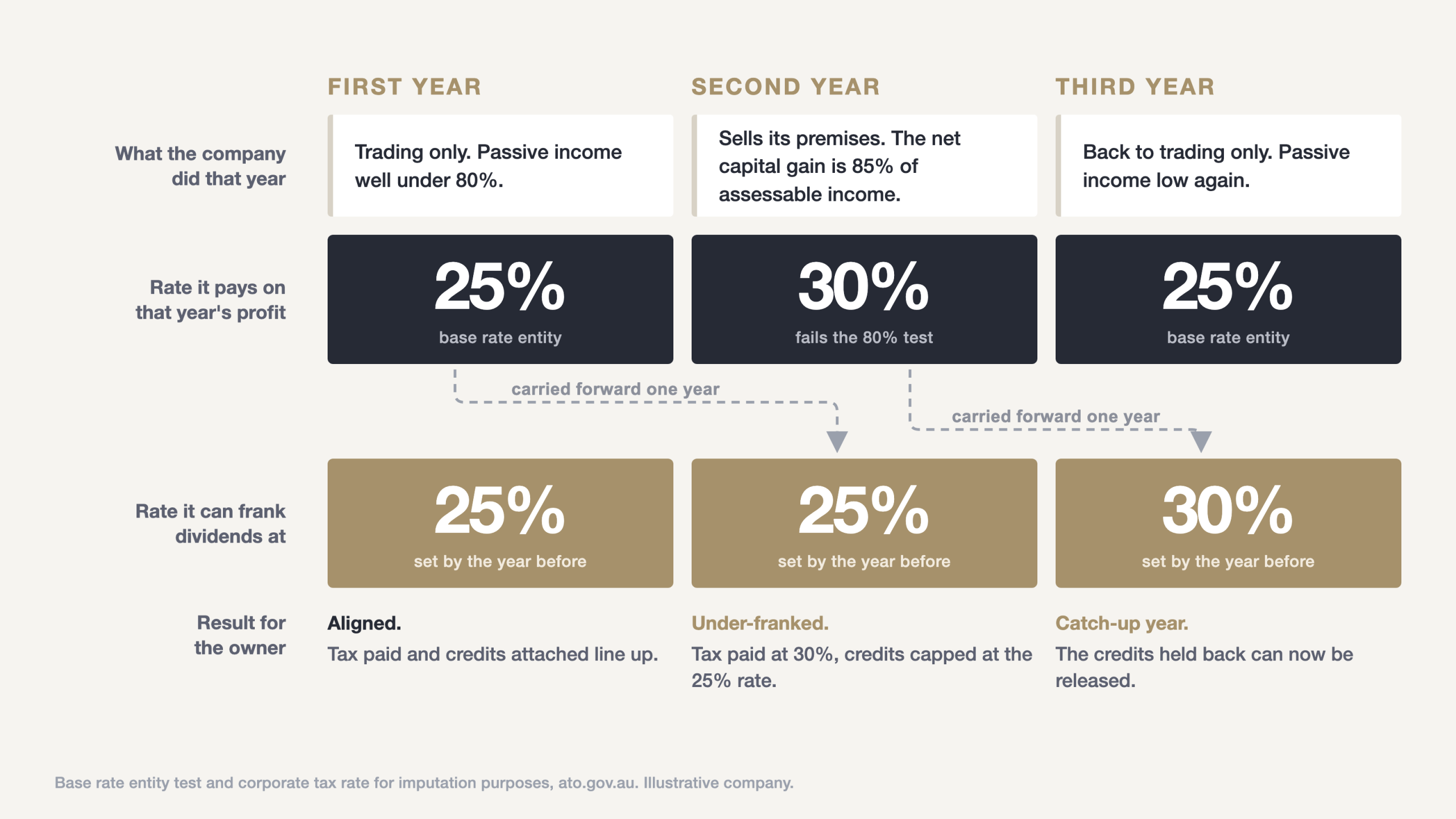
In the first year it trades and nothing else. Passive income is a rounding error, so it pays 25% and franks at 25%.
In the second year it sells the premises. The net capital gain is 85% of assessable income, so it fails the 80% test and pays 30% on its whole taxable income. Its franking rate for that same year, though, is worked out by assuming the year looks like the one before it, and the year before it was a clean trading year. So it pays at 30% and franks at 25%.
Now put a dividend through it. Say it pays $150,000 to its shareholder that year. The maximum franking credit on a distribution is the distribution divided by the gross-up rate, and the gross-up rate is 100% less the imputation rate, divided by the imputation rate.
- At a 25% imputation rate the gross-up rate is 75 divided by 25, which is 3, so the maximum credit is $50,000
- At 30% it is 70 divided by 30, which is 2.3333, so the maximum credit would have been $64,286
The $14,286 difference is not lost. It stays in the franking account, but it does not travel with that dividend, so the shareholder carries more of the tax on that profit than they would have if the two rates had matched.
In the third year the company is back to ordinary trading and pays 25%, but franks at 30%, because the assumption for this year is last year’s figures, and last year it failed the 80% test. The same dividend can now carry $64,286 of credits, and the account holds them, because the second year’s tax went in at 30%. The catch-up lands in the year after the disruption, not in it.
Three things follow. Writing a bigger number on the distribution statement does not fix it: where a statement shows credits above the maximum, the franking account is debited by the maximum only and the shareholder can claim only the maximum, so anything written above the cap is disregarded. Nothing is lost from the franking account, because those credits were never allocated in the first place.
A private company also has a single franking period, being its income year. The first frankable distribution in that period sets the benchmark franking percentage and every later distribution in the year has to match it. Frank a later one below the benchmark and the company takes an under-franking debit, which wastes the unused credits. Frank one above it and the company pays over-franking tax.
And franking beyond what the account holds leaves it in deficit at year end, which triggers franking deficit tax.
Why the headline rate is not the number that matters most
A company is a separate legal person, so profit earned in it is taxed twice: once in the company, and again in the shareholder’s hands when it comes out. Imputation stops that being double taxation. The shareholder includes the grossed-up distribution in assessable income and takes a tax offset equal to the franking credit, which the ATO calls the gross-up and credit approach. Where their marginal rate sits above the corporate rate they pay the difference, which the ATO calls top-up tax.
Follow that arithmetic and something uncomfortable falls out. Take $100 of company profit, fully distributed. At 30% the company pays $30 and attaches a $30 credit to a $70 dividend, so the shareholder is assessed on $100. At 25% it pays $25 and attaches a $25 credit to a $75 dividend, and is assessed on $100 again. Same assessable amount, same total tax, whatever their marginal rate happens to be.
So for profit that is coming out anyway, the 25% rate is worth nothing. It is worth real money only on profit that stays in the company, which makes it a deferral rather than a discount.
Which is why the next question is usually whether you can leave the profit in there and use it. The answer is Division 7A: a payment, loan or forgiven debt from a private company to a shareholder or their associate is treated as a taxable and unfrankable dividend, so the tax the company already paid does not follow it. If profit is being drawn every year anyway, the structure question is worth reopening, and how a company compares with a discretionary trust is where that starts.
Where this actually gets decided
Not in the return. By the time it is being prepared the income year is closed and both tests have already been answered by transactions you either planned or did not. The year a company sells an asset, takes on rental income, parks surplus cash or is first pulled into a group is the year to run the numbers before 30 June.
Lodgment timing is not a single date either. A self-preparing company not due earlier lodges by 28 February. A 31 October date can apply where the previous return was not lodged on time, or where any prior year return remains outstanding at the relevant date. Registered agent dates vary again, according to the ATO lodgment program and the client’s circumstances.
Crest Accountants has advised Gold Coast businesses since 1973. We prepare and lodge the company return and advise on choosing and reviewing the structure the profit sits in. Where a dividend is coming, the franking position is part of that conversation rather than something worked out afterwards. We are in Burleigh Heads and work with clients across the Gold Coast, throughout Queensland and Australia-wide.
Frequently Asked Questions
Is the company tax rate 25% or 30%?
Both, depending on the company and the year. A base rate entity pays 25% and every company that is not one pays 30%, and the status is worked out again each income year rather than applied for once.
What counts as base rate entity passive income?
A defined list, not investment income generally: corporate distributions other than non-portfolio dividends and the franking credits on them, non-share dividends, interest with narrow exceptions, royalties, rent, gains on qualifying securities, net capital gains, and trust or partnership amounts traceable to those. Rent and net capital gains push an ordinary trading company over the line most often.
Can my company pay tax at 25% but frank dividends at 30%?
Yes, and the reverse happens too. Your tax rate is worked out on that year’s figures, while your franking rate assumes this year will look like last year. When the mix changes, the two separate for a year. Check it before a dividend is declared. A distribution statement that is wrong can be amended, but an amendment cannot allocate credits above the statutory maximum, and it does not undo the consequences of an incorrect franking decision.
Does a new company get the lower rate in its first year?
For franking purposes, yes. A company that did not exist in the previous income year has no prior-year figures to assume, so its corporate tax rate for imputation purposes is the base rate entity rate. Its actual tax rate for that year still turns on its own turnover and passive income.
General advice disclaimer
The information on this page is general in nature and does not take into account your personal objectives, financial situation or needs. It is not financial product advice. Before acting, seek advice from a registered tax agent or licensed financial adviser about your circumstances.
If you are not certain which rate your company is on, or a dividend is coming up and the franking position has not been checked, talk it through with Crest Accountants on 07 5538 0999 or through our contact form. We work with company owners on the Gold Coast, across Queensland and Australia-wide.