

In short: money taken out of a private company by an owner or their associate is treated as a taxable, unfranked dividend unless it is repaid or put on a complying loan agreement by the company’s lodgment day.
Most Division 7A problems are not created by anyone trying to dodge tax. They are created by a loan account that quietly grows while the owner treats the company account as a personal one. The company is a separate legal entity, and the law has a specific mechanism for taxing its profits in your hands when you take them. It works to a deadline.
What Division 7A actually is
Division 7A sits in Part III of the Income Tax Assessment Act 1936. It is an integrity rule, there to stop private company profits reaching shareholders as untaxed cash instead of as declared dividends or wages. It operates on three kinds of transactions: a payment, loan or forgiven debt from a private company to a shareholder or an associate. Where one happens and no exclusion applies, the company is taken to have paid a dividend, whether or not anyone declared one.
Who it catches, and what counts as a loan
The rule reaches shareholders and their associates: spouses, other relatives, family trusts and entities you control. A loan to your spouse is not outside Division 7A just because your spouse holds no shares.
“Loan” is defined deliberately broadly. It covers an advance of money, the provision of credit or any other form of financial accommodation, a payment made on your behalf where there is an express or implied obligation to repay, and any transaction that in substance effects a loan. In practice, that is the director’s loan account: every time the company card covers school fees, a holiday or a car, the balance grows. “Payment” is wide too, and includes providing a company asset for your use, so a company-owned boat used on weekends can be caught even though no money moved.
What a deemed dividend actually costs you
If the amount is not repaid before the company’s lodgment day and is not on a complying loan agreement, it goes into your assessable income as a dividend at your marginal rate. And a Division 7A deemed dividend is unfrankable: no franking credit, even though the company has already paid tax on the profit that funded it.
One term is worth pinning down, because most explanations are loose about it. Lodgment day is the earlier of the due date for the company’s return and the date it is actually lodged. Lodge early and you have shortened your own window.
What this looks like with real numbers
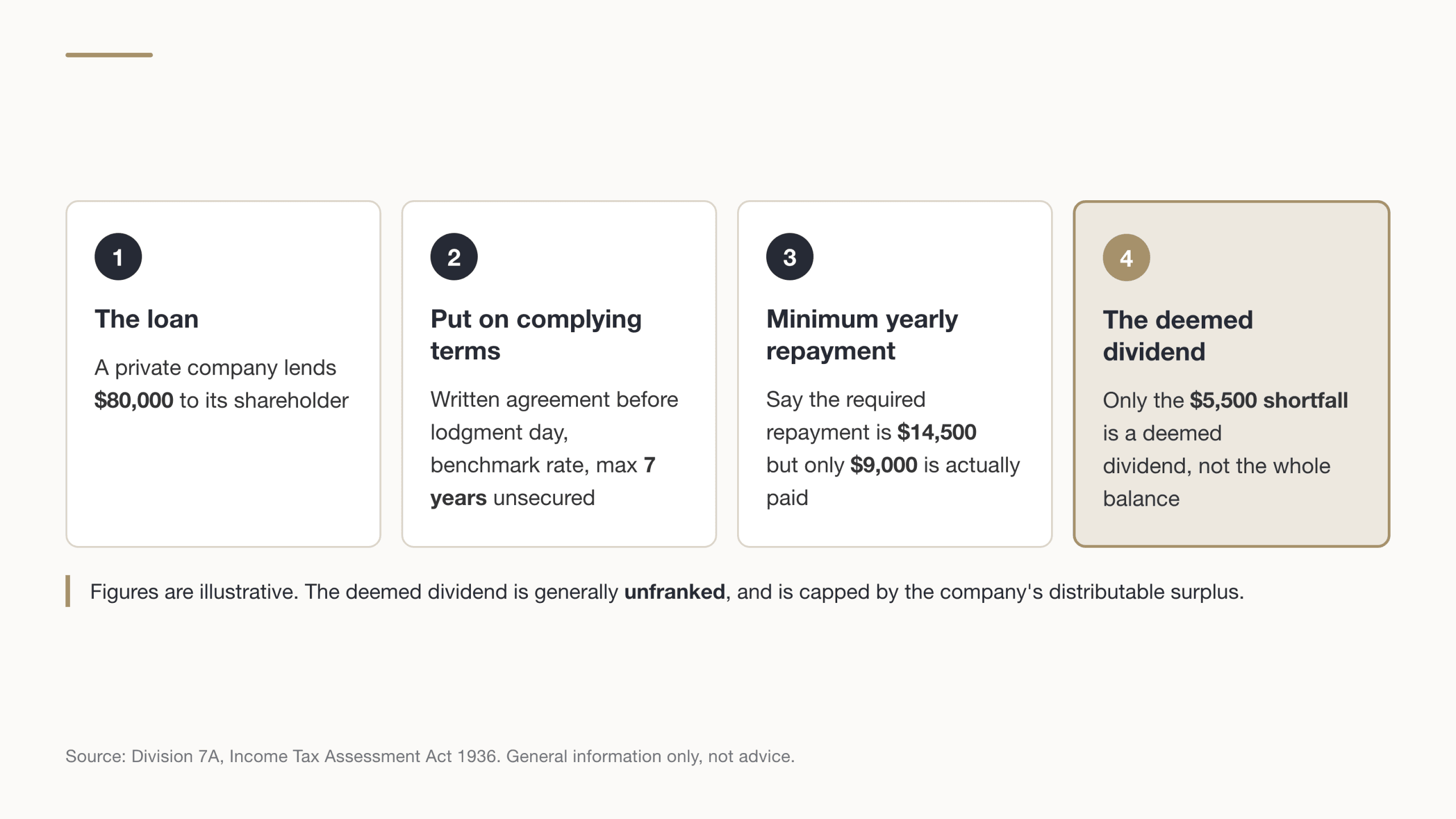
Take an owner who draws $80,000 from her company across the income year for personal spending. Nothing is documented, and the balance sits in the loan account on 30 June.
If nothing happens before lodgment day, the company is taken to have paid her an $80,000 dividend. Unfranked, at her marginal rate.
If a complying loan agreement is in place before lodgment day, there is no deemed dividend. The $80,000 becomes a real loan she has to service.
If she then misses a repayment, the damage is smaller than most articles suggest. Say the minimum yearly repayment for the next year works out at $14,500 and she pays $9,000. The deemed dividend is the $5,500 shortfall, not the $80,000 balance.
If the company’s distributable surplus were only $60,000, the first outcome is capped at $60,000. That cap is the most misunderstood part of the regime.
What a complying loan agreement has to do
Four things, all before lodgment day.
The agreement must be in writing. The interest rate for years after the year the loan is made must equal or exceed the benchmark interest rate for that income year, set from the Reserve Bank’s indicator lending rate for bank variable housing loans last published before the year starts. The ATO publishes it annually and it changes every year, so never carry last year’s number forward.
The term must be within the maximum: seven years, or 25 years where the loan is fully secured by a mortgage over real property registered under a State or Territory law and the property’s market value, after allowing for liabilities ranking ahead of the loan, is at least 110% of the loan amount. A general security agreement over company assets does not buy you the 25-year term.
Finally, a minimum yearly repayment must be made in each later income year, before the end of that year rather than by lodgment day. The ATO’s Division 7A calculator works the figure out, but it will not remind you, which is why this is the most commonly missed obligation in the regime.
Distributable surplus: the cap nobody explains
The total treated as dividends in an income year is capped at the company’s distributable surplus, and owners often hear this and relax on the basis that there are no retained earnings. That is not what the cap measures. As the ATO puts it on its own distributable surplus page, a company’s retained earnings and its distributable surplus will not necessarily be the same. The calculation starts with net assets, worked out from the accounting records as the excess of assets over present legal obligations and a defined list of provisions, then adjusts for paid-up share capital and certain earlier non-commercial loans.
And there is a sting most owners never hear about. Where the Commissioner considers the accounting records significantly undervalue or overvalue the company’s assets or provisions, the Commissioner may substitute a value considered appropriate. Internally generated goodwill and property carried at historical cost can push distributable surplus well above the number in the accounts, so a balance sheet showing nothing to distribute is not the defence it appears to be.
The traps that catch well-run businesses
Repaying and redrawing is the big one. A repayment is disregarded where a reasonable person would conclude that, when it was made, the borrower intended to obtain a similar or larger loan back from the same company, or had already obtained one in order to make the payment. Clearing the loan account in June and drawing it straight back in July does not work.
The others are unglamorous: nobody diarises the minimum yearly repayment and it is missed by a fortnight, a personal bill paid by the company is assumed not to be a loan because it never touched the owner’s account, or the whole thing is left for the accountant to find at year end, by which point the options have narrowed to whatever can still be done before lodgment day. Our guide to what puts a return in front of an ATO reviewer covers how these patterns look from the other side of the desk.
Trusts, corporate beneficiaries and unpaid entitlements
This is where most published guidance is now out of date, so it is worth being precise. Where a trust resolves to distribute income to a private company beneficiary and the cash is never paid across, the result is an unpaid present entitlement. For years the ATO treated that entitlement as capable of being a Division 7A loan. In Commissioner of Taxation v Bendel [2026] HCA 18, handed down on 10 June 2026, the High Court dismissed the Commissioner’s appeal and held by majority against that position. The ATO’s decision impact statement sets out the effect: no loan arises for Division 7A purposes where a private company beneficiary does nothing in respect of its entitlement to income from a trust.
That is a genuine change, and narrower than the headlines suggested. The ATO’s published position is that any dealing with those funds amounting to a payment or loan to, or forgiveness of a debt of, a shareholder of that corporate beneficiary or their associate may attract Subdivision EA, which deals with unpaid present entitlements. Where the entitlement arose out of a reimbursement agreement, section 100A can apply and tax the trustee at the top marginal rate instead. So the position for a bucket company is not “do nothing”: the money genuinely has to sit still.
Our explainers on how family trusts are taxed and the ATO’s scrutiny of trust distributions go further into the trust side.
If you have already got it wrong
There is a discretion, and it is narrower than its reputation. Under section 109RB the Commissioner can disregard the operation of Division 7A, or allow the dividend to be franked, but only where the result arose because of an honest mistake or inadvertent omission. The ATO treats this as a two-step process: establish the honest mistake first, and only then consider the discretion. In deciding, the Commissioner must have regard to the circumstances that led to the mistake, how quickly anyone acted to correct it, and whether Division 7A has operated against the same parties before. Relief can be made conditional. A separate provision can excuse a repayment shortfall caused by circumstances beyond the borrower’s control where treating it as a dividend would cause undue hardship.
Moving fast on a genuine error gives you something to work with. The same breach year after year does not. The durable fix is usually upstream, in how the business is structured and how owners are paid, so money leaves the company as wages or franked dividends on a plan.
General advice disclaimer
This article contains general information only and does not take into account your personal objectives, financial situation or needs. It is not tax, legal or financial advice. Crest Accountants does not hold an Australian Financial Services Licence and does not provide financial product advice. Before acting, consider obtaining advice from a registered tax agent, accountant or suitably qualified adviser about your circumstances.
Frequently asked questions
Is a Division 7A loan illegal?
No. Lending money from your own company to yourself is legitimate, and the law sets out exactly how: a written agreement by lodgment day, interest at or above the benchmark rate, a term inside the maximum, and a minimum repayment each year after. What is not allowed is taking the money and doing nothing.
Can I just repay the loan before the company lodges its return?
A genuine full repayment before lodgment day does prevent a deemed dividend. The catch is where the money comes from: a repayment is disregarded where a reasonable person would conclude the borrower intended to obtain a similar or larger loan back from the same company, or borrowed from it to make the repayment.
Are Division 7A deemed dividends franked?
No. They are unfrankable by default, so you are taxed on the full amount at your marginal rate with no franking credit to offset the tax the company already paid. The only exceptions are the section 109RB discretion and a dividend arising because of a family law obligation.
Does Division 7A apply if my company has no profits?
Possibly. The cap is distributable surplus, not retained earnings, and the two are calculated differently. Where the Commissioner considers the accounting records significantly undervalue the company’s assets, a different value can be substituted. A company with no accounting profit is not automatically safe.
Our trust distributed to a bucket company and never paid the cash across. Is that a Division 7A loan?
Not of itself, following the High Court’s decision. But if the trust then pays money to, lends to, or forgives a debt of a shareholder of that company or their associate, Subdivision EA can bring the amount back into charge, and section 100A can apply where the entitlement arose from a reimbursement agreement.
Talk it through before lodgment day
Division 7A is one of the few tax problems with a hard deadline and a good outcome available if you act before it. Once the company’s return is lodged, most of the options are gone.
If your loan account has a balance you are not sure about, or you have a bucket company and want to know where you stand, call Crest Accountants on 07 5538 0999. We are based in Burleigh Heads on the Gold Coast and have advised private company owners since 1973, working with clients across Queensland and Australia-wide by phone and video. We can review the position, get the paperwork right and handle the company tax return alongside it.