

In short: the small business restructure rollover moves your active assets into a different entity at cost instead of market value, so no income tax falls due at the time, provided the restructure is genuine, the same individuals still economically own the assets and every party chooses to apply it.
Most owners in the wrong structure know it. What keeps them there is the bill for getting out: a capital gain on goodwill built over years of trading, a balancing adjustment on the plant, and stock brought to account at a value nobody ever paid. Subdivision 328-G of the Income Tax Assessment Act 1997 removes that bill, but it is a narrow, conditional rollover whose perimeter stops well short of where most owners assume it ends.
What the rollover actually does
Two provisions do the work. The first says a transfer covered by the rollover has no direct consequences under the income tax law. The second says the law applies as if the transfer took place for the asset’s rollover cost: the transferor’s cost base for a CGT asset, the transferor’s cost for trading stock, and for a revenue asset the amount producing neither profit nor loss.
So there is no capital gain, no balancing adjustment and no profit on stock, because for tax purposes nothing was sold at market value. The receiving entity inherits the transferor’s cost, so the gain is not forgiven, only carried forward until the asset is genuinely sold. The Act adds one example worth knowing: a transfer from a company to a shareholder is not treated as a dividend under Division 7A, which outside the rollover is exactly what Division 7A is built to catch.
Who can use it, and the six conditions
The ATO’s guidance on the small business restructure roll-over sets eligibility at an aggregated turnover of less than $10 million, and aggregated turnover is not just your own revenue: it picks up every entity connected with you and every affiliate. The rollover has been available for transfers made from 1 July 2016, and it reaches active assets that are CGT assets, trading stock, revenue assets or depreciating assets. You also do not have to be a small business entity yourself. It is enough to be an affiliate of one, connected with one, or a partner in a partnership that is one, which is what lets an asset-holding entity carrying on no business take part.
Six conditions then have to be met together, and five of them sit in section 328-430 of the Act. A genuine restructure of an ongoing business, rather than a step towards selling it, under s 328-430(1)(a). Each party on the small business side of that test, s 328-430(1)(b). No material change in which individuals have the ultimate economic ownership of the asset, or in their shares of it, s 328-430(1)(c). An active asset, meaning one used or held ready for use in the relevant business, s 328-430(1)(d). A choice, by the transferor and every transferee, to apply the rollover, s 328-430(1)(f). The sixth sits separately: Australian residency for the transferor and every transferee, tested according to each party’s entity type, under s 328-445. All six, or none.
The active asset condition carries more in it than the words suggest, and special rules and exclusions sit underneath it. An asset whose main use is to derive rent will generally fail, so it is the use the asset is put to that decides it rather than the fact it is property. Shares and trust interests can qualify where the applicable active asset tests are met, but an ownership interest is not covered simply because the entity underneath it carries on a business.
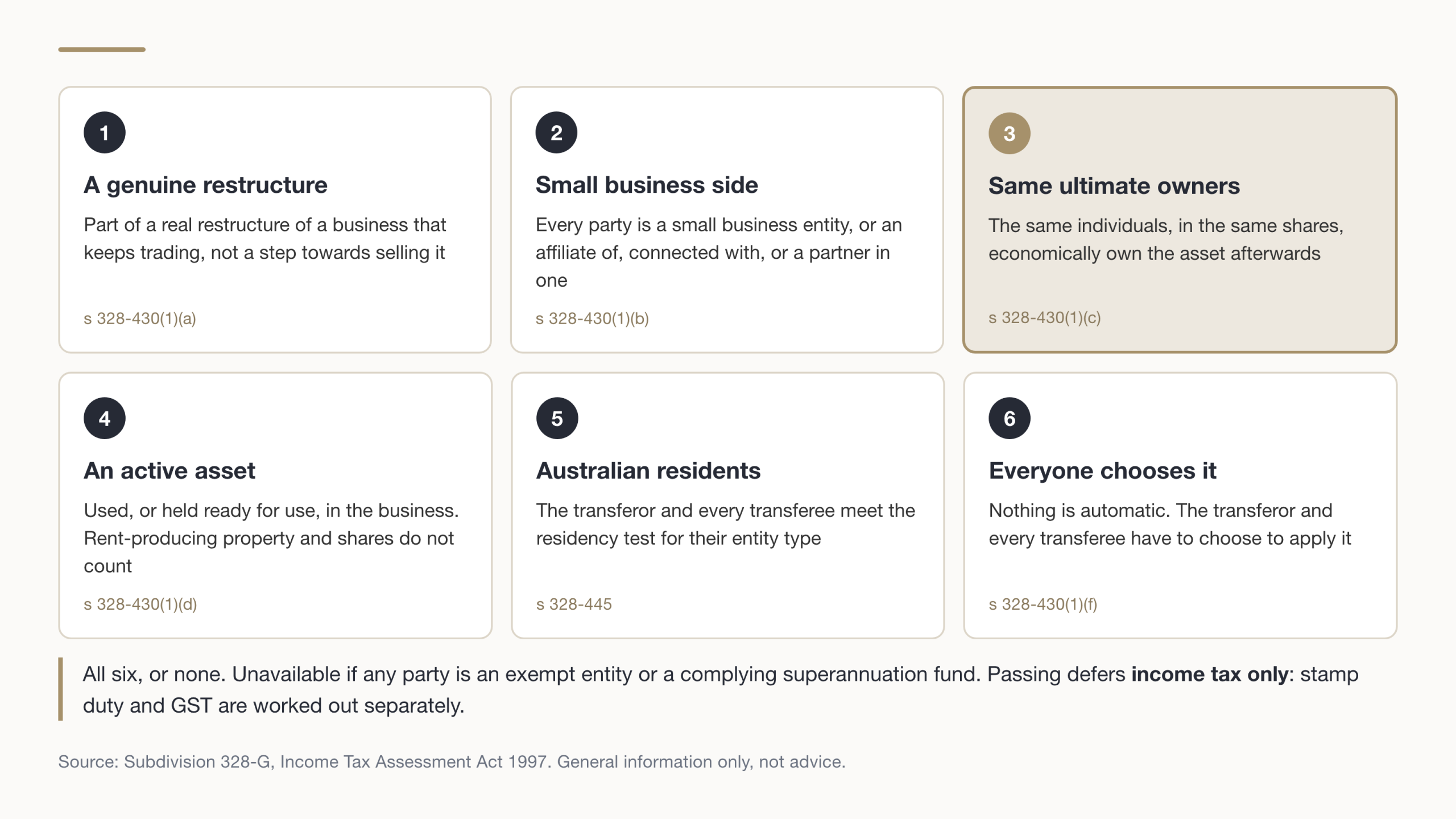
The rollover is unavailable altogether if any party is an exempt entity or a complying superannuation entity, so the business cannot be rolled into your self managed super fund. And the choice is not a formality: it is a decision the parties make and record, evidenced by the transfer documents and the way each return is prepared.
Ultimate economic ownership, and where discretionary trusts really sit
Ultimate economic ownership is held by individuals, not entities. You look through the companies and trusts to the natural persons who economically benefit, and where there is more than one, each person’s share has to be maintained too. The ATO’s own example makes the point: three equal partners incorporate, shares are issued 100, 150 and 50 rather than equally, and the rollover is lost even though the same three people still own the business.
Now the part the popular guides skip: many promote “sole trader to family trust” as a headline use without mentioning that a discretionary trust usually fails this condition. The ATO says so directly in Law Companion Ruling LCR 2016/3: a transfer of assets from or to a discretionary trust will generally not meet the requirements for ultimate economic ownership on their facts. Nobody has a fixed entitlement to trust property until the trustee exercises its discretion, so there is no individual to point at.
An alternative test exists, but it applies only where the asset sits in the property of a non-fixed trust that is a family trust, meaning a family trust election is in force just before or just after the transaction, and everyone with ultimate economic ownership on both sides of the transfer is in the family group relating to that trust.
So a discretionary trust with no family trust election gets nothing from it. And where the assets end up inside a company they are not trust property at all, so the alternative test cannot reach them. That is the ATO’s Example 12: two unrelated partners move the business into a new company whose shares are held by their family trusts, and the rollover is unavailable. The trusts hold the shares, not the assets.
Genuine restructure, and what the three-year safe harbour is not
Whether a restructure is genuine is a question of fact. The ATO looks for a bona fide commercial arrangement that facilitates growth or reduces administrative burden, continued use of the assets, continuity of people and trade, and a structure the owners would likely have adopted had they taken advice at the start. Tax can be part of the reason: the ATO expressly accepts a sole trader on the top marginal rate moving to a company for the lower corporate rate. What fails is a restructure that is really a step toward realising the business, extracting accumulated profits, or eliminating an impending tax liability.
If for three years there is no change in the ultimate economic ownership of the significant assets, those assets stay active assets and there is no significant private use of them, the genuine restructure condition is taken to be satisfied. That is all it does: an alternative route to one condition, not a seventh condition and not a claw-back. Step outside the three years and you simply revert to the ordinary test on the facts, which a restructure derailed by a divorce or an unsolicited offer may still pass.
What this looks like with real numbers
Take a landscaping business run as a sole trader, moving into a company. Goodwill built over fourteen years, cost base nil, market value $260,000. Equipment with an adjustable value of $48,000 and a market value of $95,000. Trading stock that cost $22,000 and is worth $34,000.
Without the rollover, the parties are not at arm’s length, so market value is substituted. That is a capital gain of $260,000 on the goodwill before any concessions, an assessable balancing adjustment of $47,000 on the plant, and stock disposed of outside the ordinary course of business, so assessable income picks up its $34,000 market value rather than the $22,000 it cost.
With the rollover, the capital gain on the goodwill, the balancing adjustment on the plant and the profit on the trading stock are each nil. That is not the same as the assets moving across at nothing: the goodwill transfers at its nil cost base, the company picks up the plant at its $48,000 adjustable value and keeps depreciating it on the same method and effective life, and the stock transfers at the $22,000 it cost. Each asset carries its existing tax position into the new entity instead of being treated as sold.
What has not changed is the exposure on an eventual sale. The company’s cost base for the goodwill is still nil, so the gain on a future sale is the whole of what the goodwill is worth that day, at its market value then, which may be well above or well below $260,000. The rollover defers the tax rather than removing it, and what is deferred is not fixed at today’s number.
What the rollover does not switch off
Subdivision 328-G is a Commonwealth income tax provision with no effect on state duty, and this is where restructures come unstuck.
Queensland runs its own exemption, on a different perimeter. The Queensland Revenue Office’s exemption for small business restructures covers transfers on or after 7 September 2020 from a sole trader, partnership or discretionary trust into a company. The transferring entity’s annual turnover cannot exceed $5 million, not the $10 million aggregated figure the income tax rollover uses. The assets cannot have an unencumbered value above $10 million. The receiving company must not have traded before. Shareholdings must mirror the existing ownership, with all partners or all default beneficiaries becoming shareholders, or the trustee holding all the shares. And there is no relief for land the transferor used as a residence or held as an investment property to fund the business.
A restructure out of a company, or between companies, gets the income tax rollover and no Queensland duty relief at all. Other states answer duty under their own law, so the position needs checking wherever there are dutiable assets. GST is a third question again, and the ATO notes that meeting the rollover conditions does not stop the general anti-avoidance rule applying. Nor does the rollover move your other tax attributes: it deals with assets, so carried-forward tax losses stay where they are.
The clock that restarts, and the one that does not
For the 50% CGT discount the receiving entity starts again: the ATO’s position is that the transferee must wait at least twelve months after the transfer before a CGT event happens to the asset, so the sole trader’s fourteen years of ownership counts for nothing. For the small business 15-year exemption the opposite applies, and the transferee is treated as having acquired the asset when the transferor did. Pre-CGT assets keep their status too, treated as acquired before 20 September 1985.
Put that together with the ATO’s Example 5 and the trap is clear. A sole shareholder moved his company’s active assets to himself, waited twelve months and sold to a waiting buyer, claiming a discount the company could never have used. The ATO’s conclusion was that this was a preliminary step in realising the business, not a genuine restructure, so the rollover was unavailable. Restructuring in order to sell is the one thing it will not carry.
From 1 July 2027 the 50% CGT discount for individuals, trusts and partnerships is replaced by cost base indexation and a 30% minimum tax rate on capital gains, with gains accrued to that date keeping their existing treatment. Where “the company cannot access the discount” has been the whole reason for moving an asset out, that reasoning is worth rechecking against your own numbers.
Getting the order right
A rollover answers how to move, not where to move to, and that question comes first: our guide to choosing between a trust and a company covers it. Nor is this the only route. Subdivision 122-A covers transfers to a wholly owned company and Subdivision 124-N a trust transferring assets to a company. The small business CGT concessions are different again, gated at a $2 million aggregated turnover test or a $6 million maximum net asset value test in Division 152 of the Act, so the capital gains tax position on an eventual sale belongs in the modelling beforehand.
Then the sequence matters: confirm turnover and the active asset position, settle ultimate economic ownership on both sides, make any family trust election the alternative test depends on, check duty wherever there are dutiable assets, then document the choice. That is what our business and trust structuring service is for, alongside the small business accounting that keeps the new structure compliant.
Frequently Asked Questions
Does the small business restructure rollover cover stamp duty?
No. It is a Commonwealth income tax provision with no effect on state duty. Queensland has a separate transfer duty exemption with its own conditions, including a $5 million turnover limit and a requirement that the transfer be into a company that has not traded before. Other states answer duty under their own law.
Can I use the rollover to transfer shares in my company to a family trust?
Usually not. Shares held as an investment are not active assets, and that is the common case: a shareholder moving their shareholding is moving an ownership interest, which is a different transaction from moving the business assets underneath it. Shares can be active assets where the applicable tests are met, broadly where the market values of the company’s active assets, cash and financial instruments inherent in the business make up at least 80% of the total. Where that is in play it needs to be tested on the actual numbers before the transfer, not assumed from the fact the company trades.
What happens if I sell the business within three years of restructuring?
You lose the three-year safe harbour, which is an alternative way of satisfying the genuine restructure condition, but you do not automatically lose the rollover. The question becomes whether the restructure was genuine on its facts, and where it was always a step toward the sale, the ATO’s position is that it was not.
Does a discretionary trust qualify for the rollover?
Only carefully. The ATO’s position is that transfers from or to a discretionary trust will generally not satisfy the ultimate economic ownership test on the facts. An alternative test can apply where the asset sits in a non-fixed trust with a family trust election in force, and everyone with ultimate economic ownership on both sides is inside that family group.
General advice disclaimer
The information on this page is general in nature and does not take into account your personal objectives, financial situation or needs. It is not financial product advice. Before acting, seek advice from a registered tax agent or licensed financial adviser about your circumstances.
If your structure no longer fits the business you are running, the cost of changing it is usually smaller than you think, but only if the restructure is built correctly before anything moves. Call Crest Accountants on 07 5538 0999 or send an enquiry through our contact form. We have been based in Burleigh Heads on the Gold Coast since 1973, and work with business owners throughout Queensland and across Australia.