
In short: if your business has aggregated turnover under $10 million and uses the simplified depreciation rules, you can immediately deduct the business portion of each asset that costs less than $20,000 in the year it is first used or installed ready for use, and that limit is now permanent law.
The instant asset write-off turns the cost of a business asset into a deduction in the year you start using it, instead of spreading it over the asset’s working life. For a small business replacing a laptop, a compressor or a trailer, it is the difference between claiming the cost this year and claiming it slowly over several.
The rules are simple to state and easy to trip over. Most mistakes come from three places: testing the wrong cost against the limit, assuming a car works the same way as everything else, and treating 30 June as a deadline when it is really a choice about which year the deduction lands in.
The threshold, and why it is now settled
The limit is $20,000 per asset, and the asset’s cost has to be less than that. There is no cap on the number of assets, so five qualifying assets in a year are five separate write-offs. New and second-hand assets both qualify.
For several years the $20,000 figure was extended one income year at a time, which is why so much of what you read about it still describes a deadline. That has ended. The government announced in the 12 May 2026 Budget that the limit would be made permanent from 1 July 2026, and the Treasury Laws Amendment (Tax Reform No. 2) Act 2026 received Royal Assent on 26 August 2026. The ATO now confirms the permanent $20,000 instant asset write-off is law.
| When the asset is first used or installed ready for use | Limit per asset | Status |
| 1 July 2023 to 30 June 2025 | Less than $20,000 | Law, for those years |
| 1 July 2025 to 30 June 2026 | Less than $20,000 | Law, extended by a 2025 Act for that year only |
| From 1 July 2026 | Less than $20,000 | Permanent law, Tax Reform No. 2 Act 2026 |
Earlier periods ran on very different limits, including the $150,000 temporary limit in 2020 and temporary full expensing to 30 June 2023. The ATO’s instant asset write-off page lists them if you are amending an old return. None of them applies to an asset you buy now.
Who can use it
Two conditions decide whether the write-off is available to you at all.
Aggregated turnover under $10 million. Aggregated turnover is your business’s annual turnover plus the turnover of any entity connected with you or affiliated with you. A sole trader who also controls a company, or a company inside a family group, counts the group, not just the one business buying the asset. At $10 million or more there is no current instant asset write-off, and depreciation runs under the general rules.
You use the simplified depreciation rules. The write-off is one part of the simplified depreciation rules for small business, and they are all or nothing. Choose them and they apply to all your depreciating assets except the excluded ones, including the small business pool for anything at or over the limit. You cannot take the write-off and leave the rest.
If you opted out of simplified depreciation in the past, the rule that normally locks you out for five years is suspended until 30 June 2027, so you can come back in now.
A small group of assets sits outside the simplified rules entirely and is deducted under the rules that apply to each instead, such as the capital works rules for buildings. The ATO’s list of excluded assets is:
- assets leased out, or expected to be leased out, for more than 50% of the time on a depreciating asset lease
- assets used in research and development activities
- assets allocated to a low-value pool before you started using the simplified rules
- capital works, including buildings and structural improvements
- horticultural plants, including grapevines
- software allocated to a software development pool
How the $20,000 test is applied
The test is on the asset’s full cost. The deduction is on the business portion. Those are two different numbers, and mixing them up is the most common error.
Cost means the whole cost, before private use comes off. A $24,000 trailer used 50% for business does not qualify because your share is $12,000. Its cost is $24,000, which is over the limit, so it goes into the pool.
GST comes out if you can claim it. If you are registered for GST and entitled to the full credit, the cost is the GST-exclusive price. If you can claim only part of the credit, the GST you cannot claim stays in the cost. If you are not registered, it is the price you paid, GST included. The same invoice can qualify for one business and fail for another.
Delivery and installation go in. The cost includes transport and the cost of installing the asset ready for use.
A trade-in does not reduce the cost. Trading in the old vehicle is a sale, and buying the new one is a purchase. The new asset is tested on its full price, including the amount credited for the trade-in, not on what you paid out of pocket.
Less than $20,000 means less than. An asset that costs exactly $20,000 goes into the pool.
What you then deduct is the business-use portion of that cost. A $6,000 laptop used 80% for the business is a $4,800 deduction.
Anything that fails the test goes into the small business pool, where the business portion is deducted at 15% in the first year and 30% of the pool balance in each year after. If the pool balance is under $20,000 at the end of an income year, you write off the whole balance.
Cars, utes and the car limit
Vehicles are where the write-off is most often claimed and most often claimed wrongly, because a second rule sits on top of the $20,000 test.
The car limit is the most you can use as the cost of a car for depreciation. It applies to passenger vehicles, other than motorcycles, designed to carry fewer than nine passengers and a load of less than one tonne. A ute or van built to carry a tonne or more is not a car for this purpose. The car limit for 2026-27 is $69,883, and if you pay more than that, the GST credit you can claim is capped at one-eleventh of the limit, which is $6,353.
The car limit does not stop a car being written off. It caps a car’s cost. A car that costs less than $20,000 qualifies for the write-off like any other asset. A car that costs more never reaches the car limit question for the write-off, because it has already failed the $20,000 test. The car limit only matters once a vehicle is headed for the pool.
So the rules run in this order: test the full cost against $20,000; if it fails, cap the cost at the car limit; then put the business portion of the capped cost into the pool.
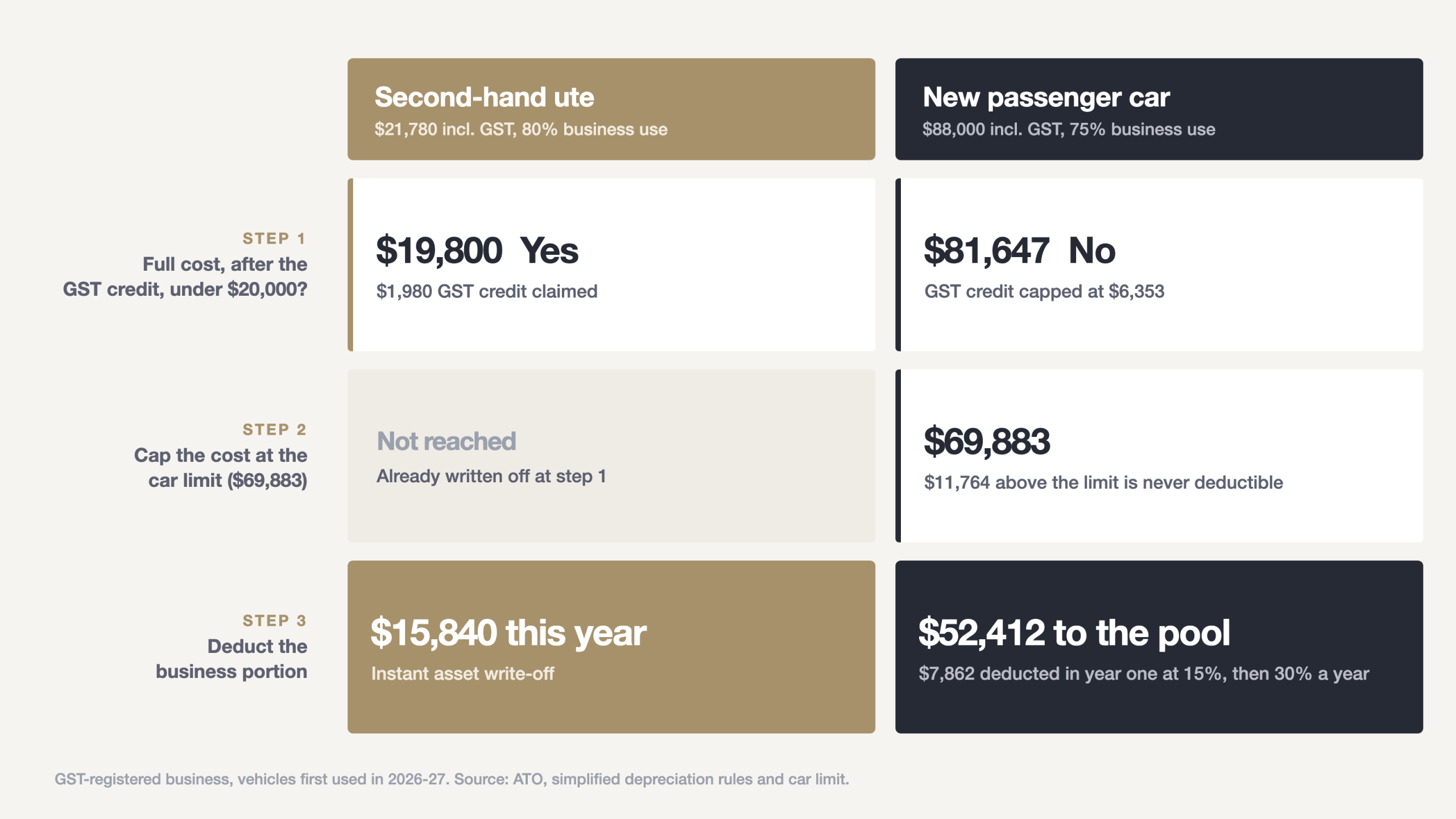
Take one GST-registered business buying two vehicles in 2026-27.
A second-hand ute for $21,780 including GST, used 80% for the business. The GST credit is $1,980, so the cost is $19,800. That is under $20,000, so it is written off: $15,840 is deducted this year. A business that is not registered for GST would test $21,780 and send the same ute to the pool.
A new passenger car for $88,000 including GST, used 75% for the business. The GST credit is capped at $6,353, leaving a cost of $81,647. That fails the $20,000 test, and it is over the car limit, so the cost is cut to $69,883. The $11,764 above the limit can never be deducted under any depreciation rule. The business portion, $52,412, goes into the pool, and the first year’s deduction is $7,862.
Two traps sit alongside the car limit.
Cents per kilometre switches depreciation off. If you claim car expenses using the cents per kilometre method, the car goes into the pool with a business use of 0%, so there is no write-off and no pool deduction for it. The cents per kilometre rate already allows for depreciation. To claim depreciation on the car, you move to the logbook method.
A company or trust car is different. Where a company or trust that uses the simplified rules owns the car, there is generally no reduction for private use: its cost, still capped at the car limit, goes through the rules, and private use by you or another associate is dealt with under fringe benefits tax rather than by cutting the deduction. The GST credit itself is claimed on your business activity statement, at the capped amount where the car limit applies.
What 30 June still decides
The write-off is claimed in the income year the asset is first used or installed ready for use. Ordering it is not enough, and neither is paying for it. A machine paid for on 20 June that is delivered and set up on 3 July is a deduction for the following year.
Now that the limit is permanent, buying before 30 June does not save a deduction you would otherwise lose. It brings the same deduction forward by one year, which is a cash-flow benefit rather than a bigger deduction. A deduction only reduces tax by the rate you pay on that income, whether that is your marginal rate or the rate your company pays, so the bring-forward is worth having when you were going to buy the asset anyway. It is not a reason to buy something the business does not need.
Two other year-end points are worth checking before 30 June. If your small business pool balance is about to fall under $20,000, it can be written off in full that year. And if you are trading in or selling an asset you have already written off, the business portion of what you get for it is generally assessable income in the year you dispose of it. For an asset in the small business pool, the proceeds reduce the pool balance instead, and if that takes the balance below zero, the negative amount is assessable income for the year. The same applies to an insurance payout on an asset written off and later destroyed. The trade-in on your next vehicle is, in tax terms, a sale of the old one.
Getting it right in the return
The write-off is claimed in your return, with no separate application. What makes it hold up is the record behind it: the invoice, the date the asset was first used or installed, the GST position, and the business-use percentage with whatever supports it. Keeping that record in Xero or MYOB as each purchase happens is far easier than reconstructing it at tax time.
Crest Accountants has looked after Gold Coast businesses since 1973. As small business accountants, we can tell you before a purchase whether it will be written off or pooled, and we prepare and lodge the business return that claims it. We are based in Burleigh Heads and work with businesses across Queensland and Australia-wide.
Frequently Asked Questions
Is the $20,000 instant asset write-off permanent?
Yes. The Treasury Laws Amendment (Tax Reform No. 2) Act 2026 received Royal Assent on 26 August 2026 and makes the $20,000 limit permanent for small businesses with aggregated turnover under $10 million, for assets first used or installed ready for use from 1 July 2026. Parliament can still change it in future, as it can any tax law.
Can I claim the instant asset write-off on a car?
Yes, if the car’s cost is less than $20,000, GST-exclusive if you are registered and can claim the full credit. Only the business-use portion is deducted. A car costing more goes into the small business pool, with its cost capped at the car limit for the year you first use it.
Does an asset costing exactly $20,000 qualify?
No. The cost has to be less than $20,000. An asset that costs $20,000 or more goes into the small business pool.
If I pay before 30 June but the asset arrives in July, which year do I claim it?
The following year. The write-off depends on when the asset is first used or installed ready for use for a taxable purpose, not when it was ordered or paid for.
Does the write-off apply to second-hand assets?
Yes. New and second-hand assets are treated the same way, and the same $20,000 test applies to both.
General advice disclaimer
The information on this page is general in nature and does not take into account your personal objectives, financial situation or needs. It is not financial product advice. Before acting, seek advice from a registered tax agent or licensed financial adviser about your circumstances.
If you are planning a purchase and want to know whether it will be written off or pooled, or a vehicle is involved and the car limit has not been checked, talk it through with Crest Accountants on 07 5538 0999 or through our contact form. We work with businesses on the Gold Coast, across Queensland and Australia-wide.