

In short: a franking credit is company tax already paid, passed to the shareholder with the dividend. It reduces the shareholder’s tax, and individuals and super funds may get any excess back as a refund. Companies do not, and a Division 7A deemed dividend carries no credit at all.
A company is a separate taxpayer, so its profit is taxed in the company and taxed again when it reaches you as a dividend. Australia’s imputation system stops that being double tax by letting the company pass the tax it has already paid to its shareholders, attached to the dividend as a franking credit.
Most explanations stop at the shareholder’s tax return. If you own a private company, run an SMSF, or both, the more useful questions sit either side of it: where the credit comes from, who can turn it into cash, and how a loan from your own company can leave the credit behind.
How imputation works: one profit, taxed once
When you receive a franked dividend, you include the dividend and the franking credit in your assessable income, then take a tax offset equal to the credit. The ATO calls this the gross-up and credit approach. Only Australian residents can claim the offset. If your marginal rate is above the company’s rate you pay the difference, which the ATO calls top-up tax. If it is below, the credit covers more than your tax on the dividend and the excess reduces tax on your other income.
Here is $10,000 of company profit, fully distributed, at each of the two company tax rates: 30% for most companies and 25% for base rate entities.
| Company taxed at 30% | Company taxed at 25% | |
| Company profit | $10,000 | $10,000 |
| Company tax paid | $3,000 | $2,500 |
| Fully franked dividend | $7,000 | $7,500 |
| Franking credit attached | $3,000 | $2,500 |
| Shareholder is assessed on | $10,000 | $10,000 |
The shareholder ends up taxed on the whole $10,000 at their own rate either way, with credit for whatever the company already paid.
The company works out the maximum franking credit by dividing the dividend by its gross-up rate, which is 100% less its corporate tax rate for imputation purposes, divided by that rate. At 30% the gross-up rate is 70 divided by 30, so a $7,000 dividend carries up to $3,000. At 25% it is 75 divided by 25, which is 3, so a $7,500 dividend carries up to $2,500.
A dividend franked to that maximum is fully franked. One with no credit is unfranked. In between is partly franked, and the franking percentage is the credit actually attached divided by the maximum. In the ATO’s own example a company distributes $11,667, could have attached $5,000 of credits, attaches $3,000, and so has franked at 60%. It cannot frank above 100%.
Where the credit comes from on the company’s side
Every company keeps a franking account. It is a running record of the tax the company can pass on, and it rolls over from one year to the next.
- Credits arise when the company pays income tax or a PAYG instalment, or receives a franked dividend of its own.
- Debits arise when it pays a franked dividend or receives a refund of income tax.
The detail that catches private companies is the word “pays”. A franking credit arises when tax is paid, not when it is assessed. Where an income tax liability is only partly paid, no credit arises for the amount still outstanding. A company on a payment plan with the ATO can have years of profit on its books and very little to frank a dividend with.
The principle behind the account, in the ATO’s words, is that a company must not give its members credit for more tax than has actually been paid. Frank past the balance and the account goes into deficit. If it is still in deficit at the end of the income year, the company pays franking deficit tax and lodges a franking account tax return by the last day of the following month. That tax can generally be offset against future income tax, but it is cash out the door early.
Two more rules govern how the credits go out. A private company’s franking period is its income year, and under the benchmark rule the first frankable dividend in that period sets the franking percentage for every later one. Frank a later dividend higher and the company pays over-franking tax. Frank it lower and the company takes an under-franking debit, so those credits are wasted. Neither breach changes what the shareholder can claim, which is the credit shown on their statement.
The other rule is timing. The rate a company franks at is worked out on the previous year’s figures, so in a year when its circumstances change the corporate tax rate for imputation purposes can differ from the rate the company paid.
Who gets excess franking credits refunded
Franking credits on dividends received on or after 1 July 2000 can be refunded to individuals once their tax and Medicare levy liabilities are met. That is why a retiree with little other income can receive a refund. The ATO’s own example: Rodney receives a $700 dividend with $300 of credits, has a basic tax liability of $200 across all his income, and is refunded $100.
The list of who is eligible for a refund is specific:
- individuals, whether they receive the dividend directly or, under the current rules, through a trust or partnership
- complying super funds, which claim through the fund’s annual return
- endorsed income tax exempt charities and deductible gift recipients
- a few narrower categories, such as life insurance companies for their superannuation business
Companies are not on it. A company’s franking offset can reduce its tax to nil but is not refunded. The excess is converted into a tax loss, by dividing it by the company’s tax rate, and carried forward. A company that receives a franked dividend also gets a matching credit in its own franking account, so it can pass the credit on to its shareholders. A bucket company holding shares does not produce a refund. It produces credits it can frank its own dividends with.
Trusts pass the credit through. Under the current rules, beneficiaries presently entitled to a trust’s franked income take their share of the credit. Proposed changes to how trusts are taxed, still in draft legislation, could change this, including whether individuals are refunded franking credits that reach them through a trust. If the trust has no income to distribute, nobody can claim the credits it received. For discretionary trusts there is a further catch in the holding period rule below, and our guide to how family trusts are taxed covers the trust side more fully.
The 45-day rule and the $5,000 exemption
To claim the offset you have to be a “qualified person”, which means passing two integrity rules for each parcel of shares.
The holding period rule requires you to hold the shares at risk for at least 45 days, or 90 days for preference shares, not counting the days you buy and sell. You only need to pass it once for each purchase.
The related payments rule stops you claiming the credit if you make, or are likely to make, a payment that passes the benefit of the dividend on to someone else.
If your total franking credits for the year are under $5,000, the small shareholder exemption applies and you only need to meet the related payments rule. At $5,000 or more the holding period rule applies, and it is a cliff rather than a cap: fail it on a parcel and you lose all the credits on that parcel, not just the amount over $5,000.
For a discretionary trust, the ATO’s position is that a beneficiary cannot hold an interest in shares at risk for the required period unless the trust has made a family trust election. Where the holding period rule applies, a missing election can cost beneficiaries the credits.
Why franking credits do more work inside an SMSF
A complying super fund pays a concessional tax rate of 15% on its assessable income, and income from assets supporting a retirement-phase pension is exempt as exempt current pension income. A credit worked out at the company rate is therefore larger than the fund’s tax on the dividend, so super funds are among the biggest beneficiaries of the refund.
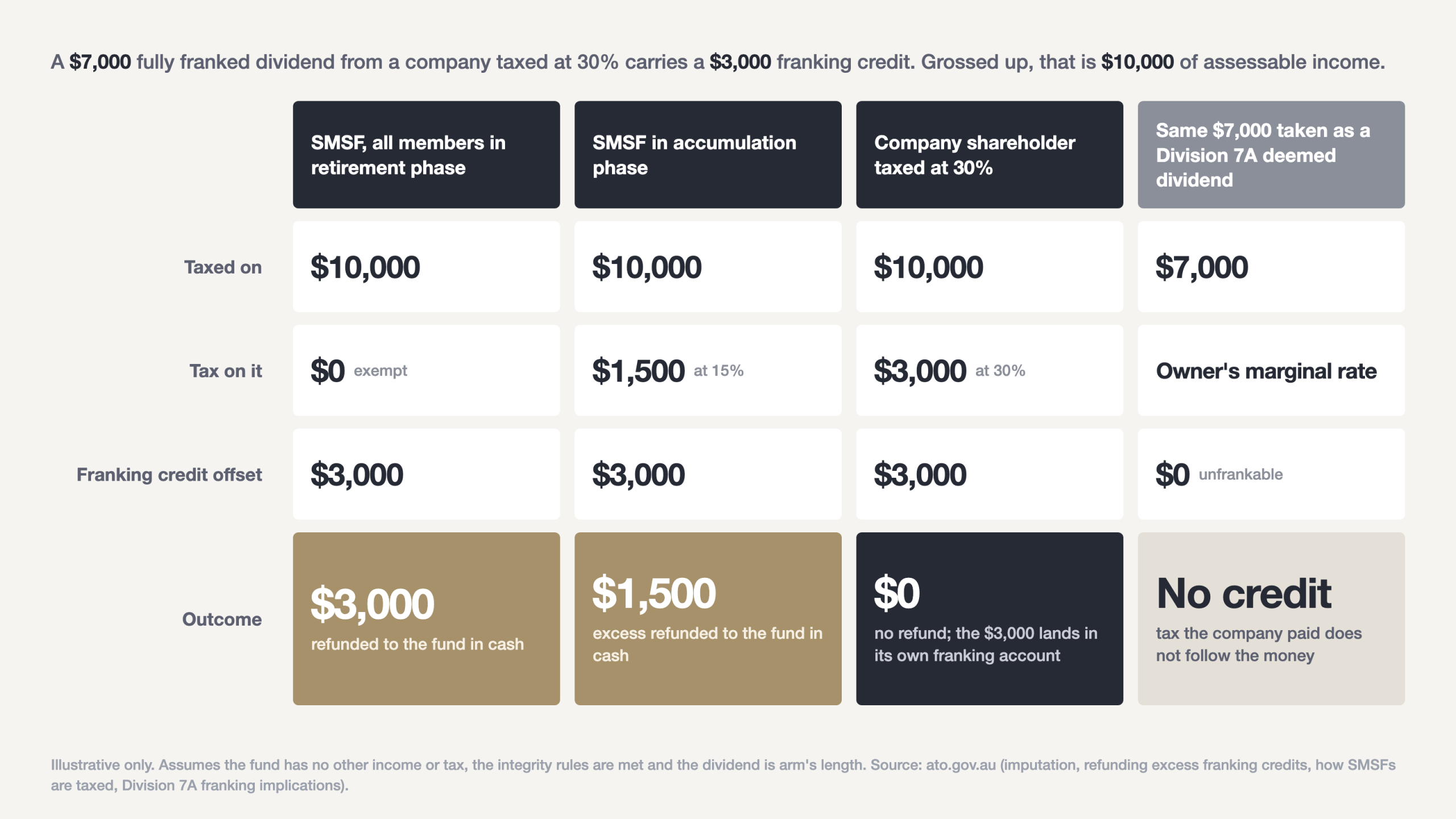
Inside a fund in accumulation phase, a $7,000 fully franked dividend from a company taxed at 30% is assessed as $10,000 and taxed at $1,500. The $3,000 credit covers that and leaves $1,500 to reduce tax on the fund’s other income, such as concessional contributions, with anything still left refunded. Where the income is exempt because it supports a pension, complying funds keep their entitlement to the offset on certain exempt income, so the whole credit can come back as cash.
ncial product decision. Crest Accountants does not provide financial product advice. We handle the fund’s SMSF accounting and annual return, including the franking credit claim, and work alongside licensed financial advisers where personal advice is needed.
Division 7A: how company money ends up with no franking credit
Profit taken out of a private company as a loan that is not repaid or put on a complying loan agreement in time is treated as a dividend under Division 7A. That deemed dividend is generally not frankable, and the recipient gets no offset. The company has already paid tax on the profit, and you pay tax on the same money again at your marginal rate, with nothing to show for the first lot. That is the far right column of the graphic above.
The tidier route is usually a declared, franked dividend, and the two can work together. Where a loan is on a complying agreement, the ATO accepts a dividend payable to the borrower, offset against the loan balance, as a repayment. It is one of the payments the ATO always takes into account, even where you intend to borrow again, which a cash repayment in that situation would not get. Say the company, with a 25% rate for imputation purposes, declares a $15,000 fully franked dividend in June. That carries a $5,000 credit, you are assessed on $20,000 with a $5,000 offset, and the $15,000 goes against the loan.
The conditions are strict. Both debts have to exist at the time, the company must validly declare the dividend and have the capacity to pay it, and you and the company have to agree to offset them. The agreement and the offset must both be made by the end of the income year, usually 30 June. The ATO is explicit that a journal entry recording a dividend after year end, with nothing contemporaneous behind it, will not satisfy a minimum yearly repayment.
Where a deemed dividend has already happened, a later dividend set off against it is treated in two parts. The unfranked part of the later dividend, up to the amount set off, is not taxed again as a dividend. The franked part is still a dividend and keeps its credits. In the ATO’s example, a shareholder with a $1,000 deemed dividend has it set off by a later $1,000 dividend franked at 35%. The $650 unfranked part drops out, and the $350 franked part is assessed with its $150 credit and a $150 offset. The company must still frank the later dividend in line with the benchmark rule.
The only other way to frank a deemed dividend is for the Commissioner to allow it under the discretion for honest mistakes and inadvertent omissions, which cannot be assumed. Our full guide to Division 7A covers complying loan agreements, the benchmark interest rate and the repayment-and-redraw trap.
Plan the franking before the dividend is declared
Most franking problems are locked in by the time the return is prepared. The franking account balance, the benchmark percentage, the imputation rate and whether a Division 7A repayment was covered by a dividend all depend on what happened before 30 June.
Crest Accountants has advised private company owners and SMSF trustees since 1973. As a registered tax agent we prepare and lodge the company return and look at how the structure is set up, so a dividend is planned with its franking, its Division 7A position and the shareholder’s tax in view at the same time. We are based in Burleigh Heads and work with clients across the Gold Coast, throughout Queensland and Australia-wide.
Frequently Asked Questions
Do I get franking credits back if I pay no tax?
Usually, yes. An Australian resident individual whose franking credits exceed their tax and Medicare levy liabilities is refunded the excess, provided they meet the integrity rules. If you are not otherwise required to lodge a tax return, you can apply to the ATO for the refund separately.
Can my company get a refund of franking credits?
No. A company’s franking offset can reduce its tax to nil, but any excess is converted into a tax loss and carried forward rather than refunded. The company also receives a matching credit in its own franking account, which it can attach to the dividends it pays.
How do I calculate the franking credit on a dividend?
For a fully franked dividend, divide the dividend by the company’s gross-up rate. For a company franking at 30% that is the dividend multiplied by 30/70, and at 25% it is the dividend multiplied by 25/75. The amount is shown on your dividend statement, which is the figure you claim.
Do franking credits work differently in an SMSF?
The mechanics are the same, but the fund’s tax rate is 15%, and income supporting a retirement-phase pension is exempt. A credit worked out at 25% or 30% therefore usually exceeds the tax on the dividend, and the excess is refunded through the fund’s annual return. Dividends from a related private company must be on arm’s length terms or they are taxed at 45%.
Is a Division 7A deemed dividend franked?
No. Deemed dividends are generally unfrankable, so you are taxed on the full amount at your marginal rate with no credit for the tax the company has already paid. A franked dividend properly declared and offset against a complying loan before 30 June is treated differently and keeps its credits.
General advice disclaimer
The information on this page is general in nature and does not take into account your personal objectives, financial situation or needs. It is not financial product advice. Before acting, seek advice from a registered tax agent or licensed financial adviser about your circumstances.
If a dividend is coming up and the franking, the loan account or the fund’s position has not been checked, talk it through with Crest Accountants on 07 5538 0999 or through our contact form. We work with company owners and SMSF trustees on the Gold Coast, across Queensland and Australia-wide.